Free Roof Inspection STL / Station 01
Nine stops, walked in order, every one photographed
This is the route Keys walks on your house, stop by stop, and every stop leaves a dated frame in the set you keep. Name the junction you are worried about when you book and it goes to the front of the walk.
Stop one is the garden, and it takes four minutes
The house gets walked around at ground level before the ladder comes off the truck, and a surprising amount of the report is decided here. Ridge lines are read for sag. Slopes are read for the wave that says the decking underneath has moved. Gutter lines are read for pitch and for separation at the seams. Downspouts are followed to wherever they let go, and the ground at that point is read for a scour hole or a soft patch against the foundation. Then the ladder goes up, which is the part a kerbside verdict skips entirely.
Fascia and soffit are read for rot and for staining, because a brown stain on a soffit board is water that has already been in the roof and come back out. Any obvious debris on the ground gets picked up and looked at: a granule drift at the bottom of a downspout, a piece of ridge cap in a flower bed, a length of drip edge in the grass. Those are all findings, and they are all findings you can make yourself this afternoon without a ladder.
The eave, the drip edge and the first course
The ladder goes to the eave, and the eave is the first proper stop. The starter course is checked for adhesion. The drip edge is checked for presence at all, because on older houses in this metro there frequently is not one, and then for whether it sits over the gutter or behind it, which decides where the water goes when the gutter is full.
The first three or four courses are the ones that see the most ice, the most standing water and the most wind lift, so they are also the ones that tell you fastest whether the last install was careful. Cupping, curling at the tab corners and clawing all show here before they show anywhere else on the plane.
The field of shingles, read for four things
Once the roof is walked, the field is read for granule loss, for mat exposure, for lifted or missing tabs, and for the sealant strip. Granule loss shows as pale patches where the asphalt below is starting to show through, and it is the ordinary way an asphalt roof ages: sun, thermal cycling, and thirty or forty freeze and thaw crossings a year in this climate.
The sealant strip is the one that catches people out. Modern architectural shingles are held down as much by the adhesive strip as by the nails, and once that strip has released, a shingle can look perfect and still lift in a wind that would not have moved it when it was new. Checking it means lifting tabs by hand across the plane, which is why it can only be done on the roof.
Wear and damage are different findings. A worn roof has aged in an ordinary way and will need replacing on a schedule. A damaged roof has had something happen to it. Both are worth writing down and they should not be written down as the same thing.
Every hole in the roof, individually
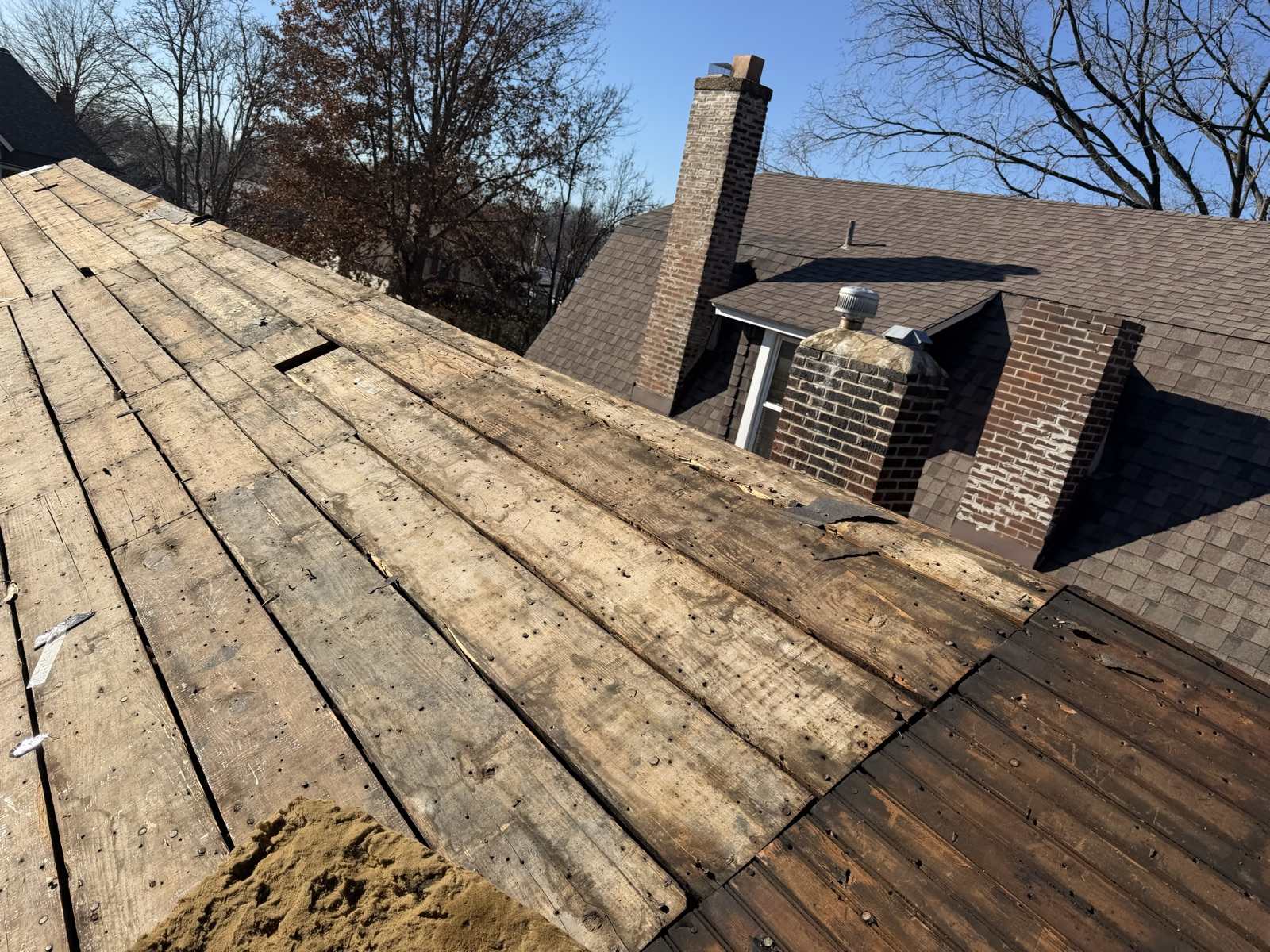
A roof plane does not leak. The holes in it leak. So every penetration gets handled on its own: plumbing vent stacks, furnace and water heater flues, bathroom and kitchen exhausts, any powered vent, satellite mounts, and every abandoned fixing that somebody left behind.
Pipe boots get the closest look, because the rubber collar on a plumbing vent perishes in ultraviolet and splits, and it does that reliably before the shingles around it are finished. A split boot is a small, cheap repair and a slow, expensive leak, which is a bad combination for anyone who is not looking. Metal flues get checked at the storm collar and at the base flashing, and abandoned mounts get flagged, because an old satellite bracket screwed through a roof is four holes with nothing over them.
Flashing, which is where roofs actually leak
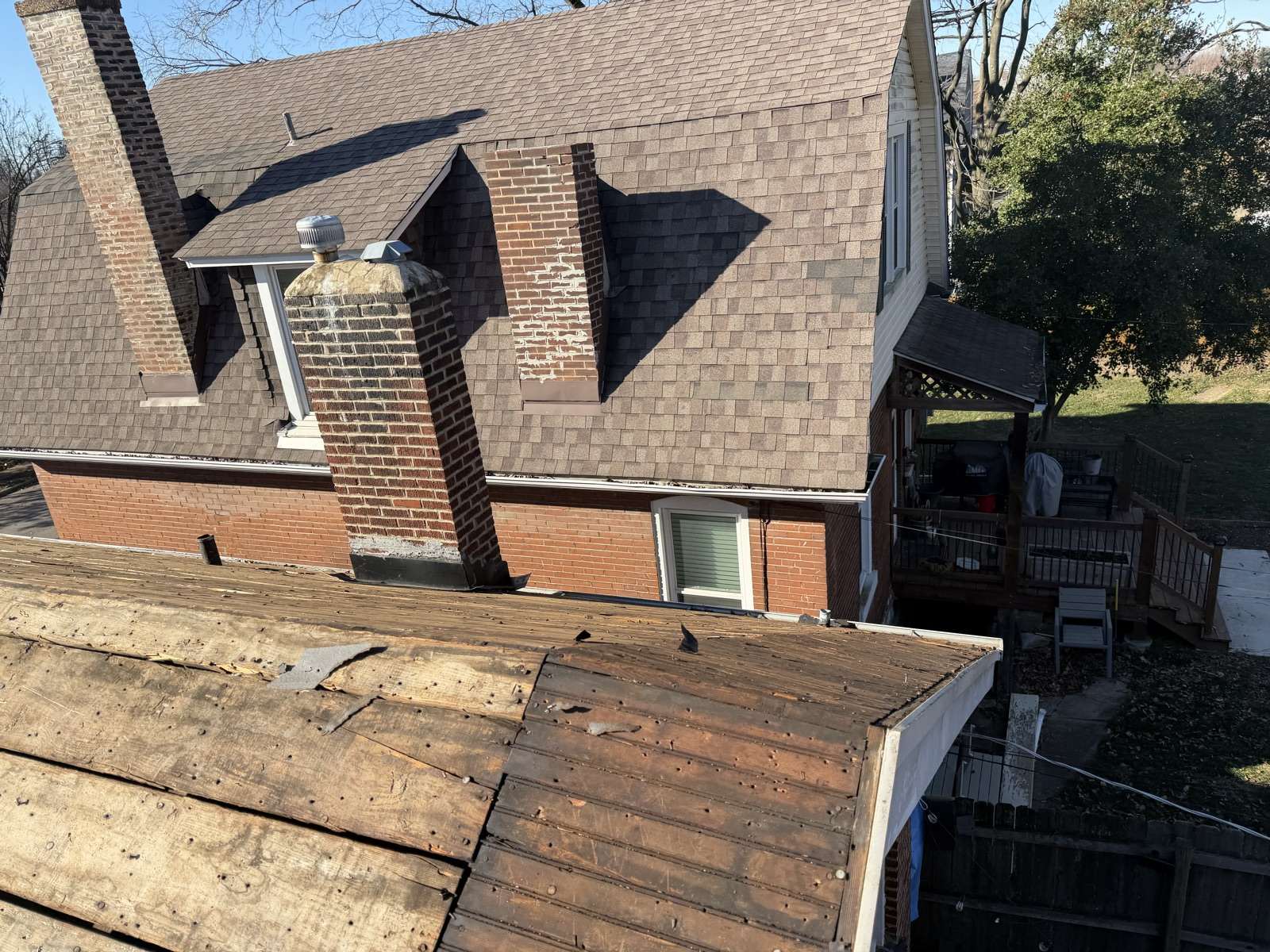
Where a roof plane meets a vertical wall or a chimney, it is not shingles that keep the water out. It is metal. Step flashing runs up the sides, one piece per course, woven into the shingles. Counter flashing is let into the mortar joint above it and laps over the step. At the low side of a chimney there is an apron, and behind a wide one there should be a cricket so the water is thrown around rather than being asked to sit in a corner.
The failures are ordinary and they are all findings. Step flashing that was reused from the last roof and is holed. Counter flashing that was surface sealed to the brick with caulk rather than let into the joint, which lasts a few winters and then does not. A chimney whose crown has cracked or whose brick faces are spalling, which is masonry work rather than roofing but which will put water into the same ceiling. All of it belongs in the report even where the fix is not a roofer's.
Valley metal, where the water concentrates
A valley carries the water off two planes at once, so it moves more water faster than anywhere else on the roof and it is the place where debris collects. Three common treatments, and each gets looked at differently. An open valley shows its metal, so it can be read directly for corrosion, for fastener holes in the wrong place, and for the fold down the centre. A closed cut valley has one plane run through and the other cut back over it, so what gets read is the cut line and whether the underlying metal or membrane extends far enough under it. A woven valley has both planes laced together, which is durable and hard to inspect, so it is read for lifting and for wear along the line where the water actually runs.
In every case the valley gets cleared and looked into rather than looked at. A valley full of maple keys and shingle grit is holding water against the roof, and in this metro, with the tree cover most of these neighbourhoods have, it is one of the most common findings there is.
Nails, which decide whether an install survives wind
A shingle is held by four or six nails and it matters where every one of them went. High nailing is the classic: the nail placed above the nailing strip so it catches only one layer instead of two. It looks identical from the ground and from the kerb, and it is the reason a five year old roof can lose tabs in a wind that a twenty year old roof shrugs off.
Overdriven nails cut through the mat. Underdriven nails stand proud and telegraph through the course above, and eventually back out and tent the shingle. Any of these found in a pattern is a workmanship finding rather than a weather finding, and the difference is worth having in writing, because the two are resolved in completely different places.
The ridge, the vents and what is meant to be moving
At the top of the walk, exhaust gets counted and identified: ridge vent, box vents, turbines, powered units, or some combination that somebody added over three decades without removing what was already there. Mixed exhaust types on one attic space are a finding, because they short circuit each other and the roof stops breathing the way anyone intended.
Then intake gets checked at the eave, which usually means going back down the ladder and looking up into the soffit. The whole of this is on ridge, soffit and attic, because it is the half of a roof that nobody sells, everybody blames later, and it is the cheapest thing on this list to get right.
Gutters, downspouts and where the water ends up
The last stop is the water's exit. Gutter pitch, hanger spacing, seam condition, whether the gutter is holding standing water, whether the guards that were fitted are doing anything, and whether the downspouts are actually connected along their length. Then the discharge point: how far from the wall it lets go, whether the ground falls away from the house there, and whether there is an extension that somebody has since removed and mowed over.
None of this is glamorous and all of it is on the same system, so it is on the same report. See gutters and discharge for the detail. What should come out of all nine stops is on the written scope.