Free Roof Inspection STL / Station 03
Hot upstairs rooms and ice at the eaves are the same fault
Both of those are the attic, not the shingles, and neither can be judged from the ground or from the ridge. Where there is safe access Keys goes inside on the same visit, photographs the soffit, the baffles and the exhaust, and puts it in the same written scope as the roof.
A roof breathes bottom to top, or it does not breathe
Ventilation is not a set of vents, it is a path, and the path is what gets checked. Cool air enters low at the soffit, moves up the underside of the decking, and leaves high at or near the ridge, carrying heat and moisture out of the assembly as it goes. Block or omit either end and the path does not exist however many vents are fitted, which is why counting vents from the pavement tells nobody anything and why this stop needs a person in the attic.
This is why the single most common ventilation finding on a St. Louis house is not a shortage of exhaust. It is a shortage of intake. Somebody added box vents or a ridge vent at some point, the soffit was never opened up or has since been packed solid with blown insulation, and the roof has plenty of exit and nothing coming in.
What an inspection actually checks
- What exhaust exists, and of how many types. Ridge vent, box vents, turbines, powered units, gable louvres.
- Whether types are mixed on one attic space. This is a finding on its own.
- Whether a ridge vent is actually cut in. Ridge vent laid over an uncut ridge deck is real and it is not rare.
- What intake exists at the eave. Soffit vents, continuous perforated soffit, or nothing.
- Whether the intake is blocked. From inside, at the eave, looking for insulation packed into the space or the absence of baffles.
- The underside of the decking. Staining, frost marks in winter, rusted nail points, any darkening around a penetration.
- Bathroom and kitchen fans. Whether they terminate outside or simply into the attic, which is common and quietly destructive.
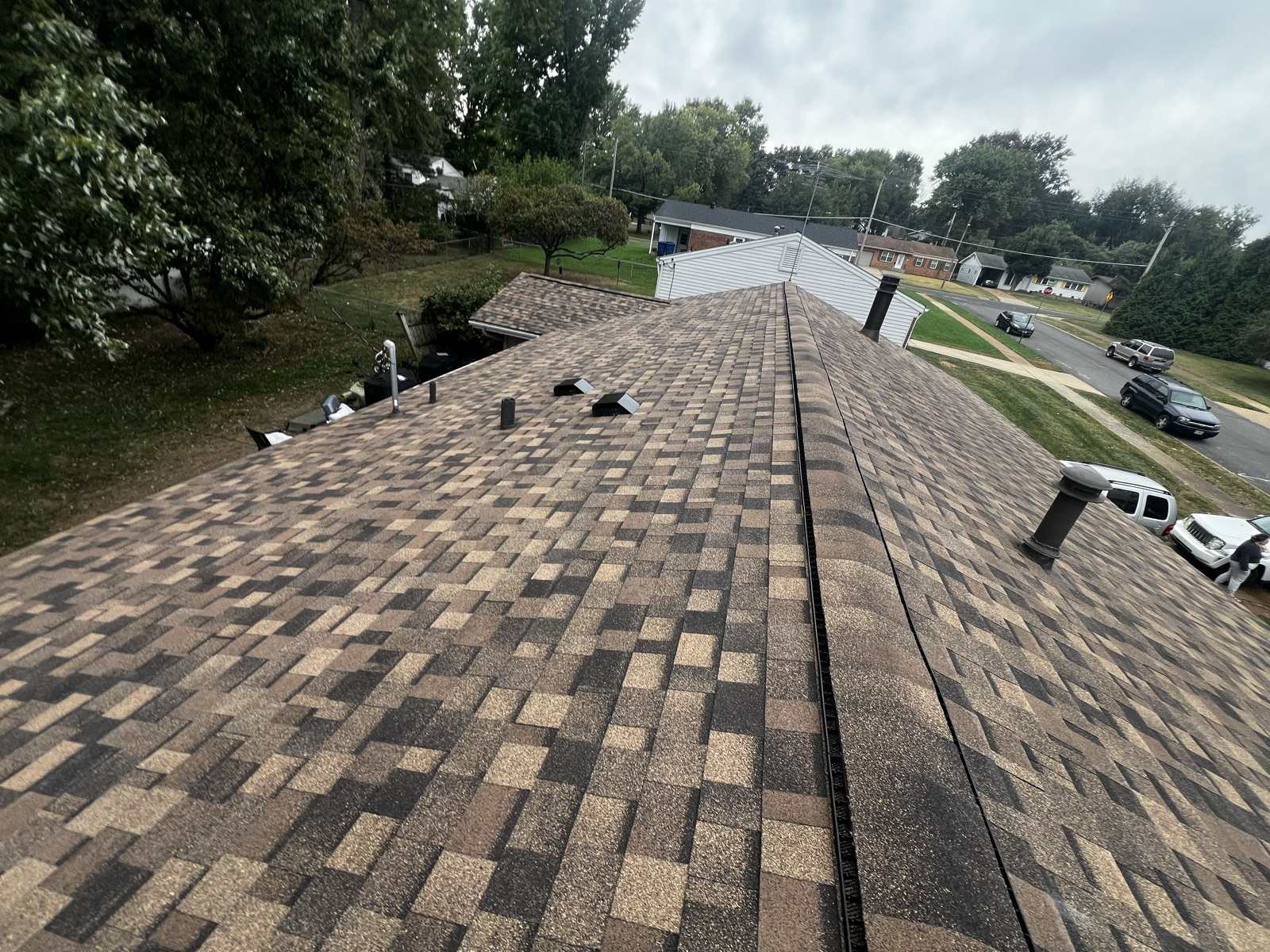
Why mixing exhaust types makes it worse, not better
It is intuitive that more vents mean more ventilation. For exhaust on a single attic space, it is usually the opposite. Air takes the easiest path, so if a ridge vent and a set of box vents share one space, the ridge vent will pull air from the box vents rather than from the soffit. The convenient nearby opening becomes the intake and the eave is bypassed entirely, so the far end of the attic stops moving air at all.
The same happens with a powered fan added to a passive system: it takes its air from whatever is easiest, which is often the other vents, and in an unusually bad case from the house itself through gaps around light fittings. That is a finding worth having in writing, because the fix is usually to remove or seal something rather than to buy anything.
What poor ventilation actually costs you
- Attic temperatures far above ambient, which pushes into the rooms below.
- Accelerated ageing of the shingles from underneath as well as above.
- Cooling equipment running longer to hold the same temperature.
- Warm moist air condensing on cold decking, then frost, then a wet ceiling in a thaw.
- Ice dams at the eave, where snow melts on a warm roof and refreezes at the cold overhang.
- Rot in the decking and rust at the nail points, which is invisible until a tear off.
Ice dams in particular get treated as a gutter problem in this metro and they are not. They are a heat problem. A gutter is simply where the ice becomes visible.
The balance, in plain terms
The convention the trade works to is that intake and exhaust should be roughly equal, and if anything intake should be slightly greater. Vents are rated by net free area, which is the actual open area after the louvres and insect mesh are accounted for, and it is always less than the size of the hole. That is why counting vents is meaningless and the rating matters.
Practically, for a homeowner, there are only two questions worth asking a roofer. How much intake does this house have, and is it more or less than the exhaust. If the answer is a shrug or a number of vents rather than an area, the calculation has not been done.
The part you can check yourself
If you can get into the loft safely, take a torch and go to the lowest point at the eave, where the rafters meet the wall. You are looking for daylight, or for a plastic or cardboard baffle holding a channel open above the insulation. If the insulation is packed hard into that corner with nothing holding a gap, the intake is blocked, and that is true no matter what is fitted outside.
While you are there, look at the underside of the decking with the torch across it rather than straight at it. Dark staining, especially around a penetration or in a corner, is a record of condensation or of a leak, and it is one of the few roof findings a homeowner can make without leaving the ground.
Ventilation is the cheapest thing to correct during a tear off
When the roof is off, cutting a ridge slot, adding soffit intake and fitting baffles are small line items in the middle of a large job. Done later, each becomes its own visit. So this is the one finding that most deserves to be on a scope before the work rather than after it.
Which means it needs to be named on the document. See the written scope for what that line should say, and after the inspection for how the rest of the decisions follow.