Free Roof Inspection STL / Afterwards
What lands in your inbox after the ladder comes down
The photograph set and the written scope, within a few working days, followed by one of three outcomes. Two of the three involve no work at all. Here is exactly what each one looks like on paper before you book, so you can check the file against this page when it arrives.
Nothing to do, which is the most common result
On a roof that is not old and has not had anything happen to it, the usual outcome is that there is nothing to do, and that gets written down and sent with the photographs rather than delivered as a shrug at the kerb. The write up names anything that is fine now and will not be in a few years: a pipe boot starting to perish, a sealant joint at a chimney with another couple of winters in it, a gutter run beginning to hold water. That document is what you show the next person who knocks.
That document is the thing this whole site is arguing for. It costs nothing, it is dated, and it is what you hold up the next time somebody tells you at your own front door that your roof is finished.
A repair, which should be described before it is priced
Repairs are ordinary: a pipe boot, a section of step flashing, a length of ridge cap, a run of valley, a few shingles. The thing to insist on is the same as always. A description first, a number second. A repair scope should say what is being removed, what is going back, and what is being matched to.
Matching is the honest limitation on a repair to an older roof, and it is worth hearing about before the work rather than after. A shingle made today will not sit invisibly beside a shingle that has been on a roof for a decade, whatever the colour name says, because the existing surface has weathered. A good repair is a sound repair, not an invisible one, and anybody promising invisibility on an aged roof is promising something the material does not do.
A replacement, and the decision behind it
Replacement becomes the reasonable answer when repairs stop being economic: when the field is worn across all slopes rather than in one place, when the sealant strips have released generally, when there is more than one layer already on, or when the same roof keeps needing attention in different places. That is a judgement rather than a rule, and it should be explained rather than asserted.
Keys installs Atlas and Malarkey shingles, so a Keys replacement scope names one of those. What matters more than the name on the bundle is what the rest of the scope says: tear off to the deck, what underlayment, where the ice barrier stops, which flashings are new rather than reused, how many pipe boots, and what happens to the ventilation. See the written scope.
The one thing nobody can tell you until the roof is off
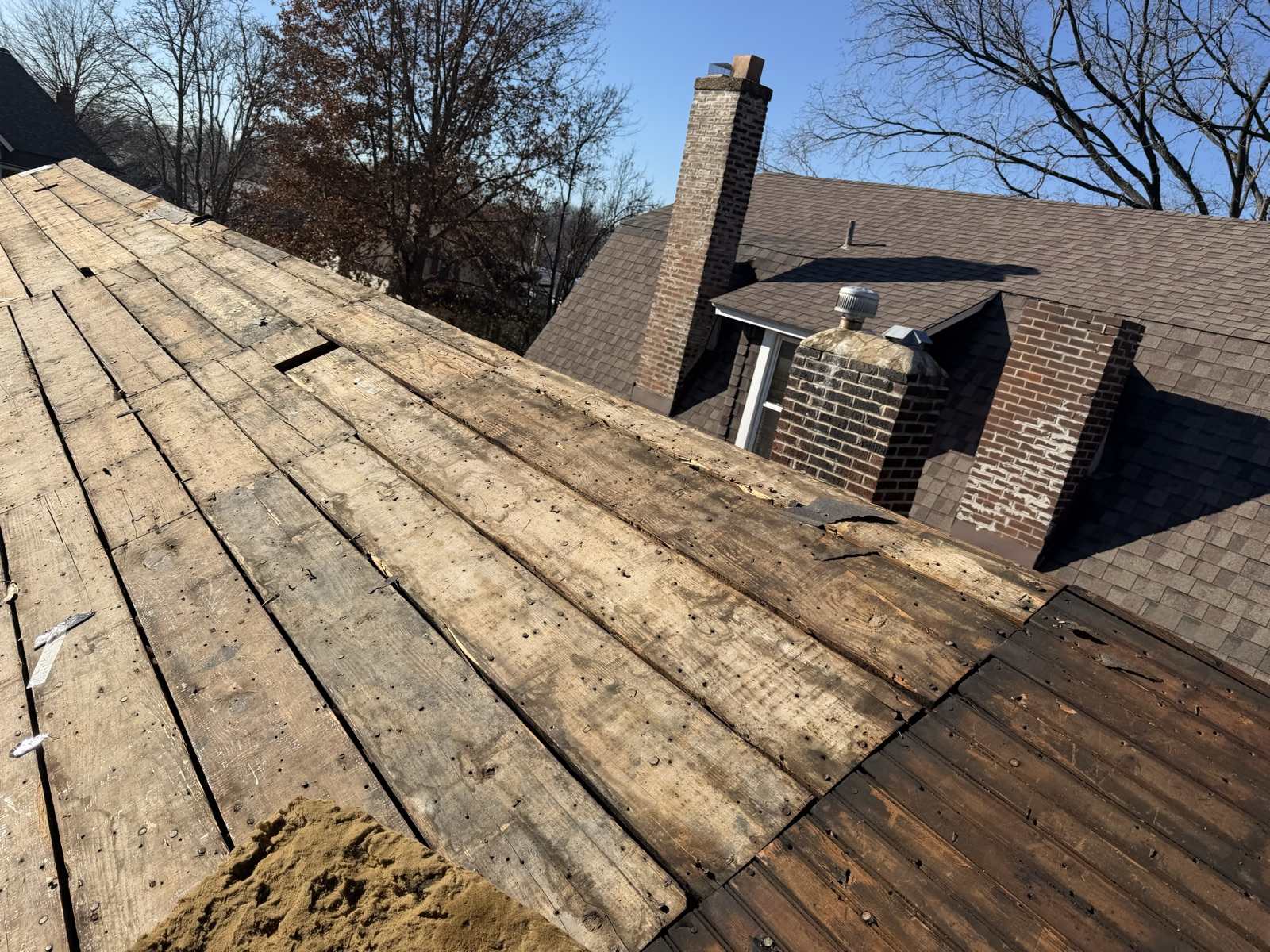
The condition of the decking. It is under the shingles, under the underlayment, and it cannot be seen from above through a finished roof. An experienced inspector can form a view from the shape of the plane, from any soft spots underfoot, and from the underside in the attic where there is access, and that view is genuinely useful, and it is still a view.
So every honest replacement scope carries a decking allowance and a unit rate: an expected quantity, and what it costs per board or per sheet if more of it is bad than expected. Settle that number before the job, in writing. A scope with no decking line is not cheaper. It is a conversation that has been deferred to the day the roof is open and you are least able to shop around.
What is the decking allowance, what is the rate beyond it, and will I be shown the boards before they are replaced. All three have simple answers if the company intends to behave well.
The permit question, honestly and by county
In unincorporated St. Louis County, a like for like asphalt reroof on a slope of 4:12 or steeper generally does not require a permit. A permit is required below that pitch, if more than a quarter of the decking is being replaced, or if the material is changing. Municipalities inside the county run their own rules on top of that, and Ballwin and Kirkwood operate their own contractor licensing, so the answer genuinely depends on which side of a boundary the house sits.
For St. Charles County, do not take a definitive rule from any website including this one. The official guidance has moved and the sources that repeat it disagree with each other. Call the St. Charles County building division and ask about your specific address and your specific work. It is one phone call and it is the only reliable answer.
Either way, the permit is a matter for you and the contractor jointly, and it should be named on the scope: who pulls it, who pays for it, and what happens if an inspection requires something extra.
What the work itself looks like from your side
A typical single family reroof in this metro runs one to three days depending on the size, the pitch, the number of layers coming off and the weather. A skip or a dump trailer arrives, usually on the drive. The old material comes off in sections, so the roof is not opened up all at once. Decking is repaired as it is exposed. Underlayment and ice barrier go down, then flashings, then the field, then the ridge and the vents.
Things worth agreeing beforehand: where the skip sits, what happens to anything stored in the loft, whether pictures come off interior walls, and how the clean up runs. Nails end up in grass and in drives, so a magnet sweep at the end of each day rather than only at the end of the job is a fair thing to ask for.
Close the file properly
Whatever the outcome, put the paperwork somewhere you will find it. The scope, the photographs from before, any photographs taken during the work with the deck exposed, and the invoice. Those deck photographs are worth keeping specifically, because they are the only record that will ever exist of what was under there.
Then start the annual ground level set again from the new baseline. The reasoning is on the photograph set, and if anything happens between now and then, the sequence to expect is on soft metal first.