Free Roof Inspection STL / Station 02
Give us the storm date and the soft metal gets read first
Aluminium takes a dent and keeps it. A shingle can absorb the same impact and show almost nothing from six feet away. So on a storm call the order of the walk changes, and the metal you can reach from a ladder gets read, photographed and dated before anybody offers you an opinion about your roof.
Why the order changes the morning after
On a routine inspection the walk goes from the ground up, in the order set out on the walk. After hail it does not. Every piece of thin, soft metal on the property gets read and photographed first, and the shingles come later, because the metal is the surface that will still be telling the truth in six weeks when somebody asks whether the marks were there before.
The reason is material behaviour. Aluminium gutter stock, downspout stock, thin steel vent caps and the fins on a condenser are soft and thin, so an impact deforms them permanently and visibly. An asphalt shingle is a flexible mat with granules embedded in it, and depending on temperature, age and the size of what hit it, an impact can bruise the mat without displacing enough granules to be obvious. The soft metal, in other words, is a recording surface, and the roof is not always one.
What counts as soft metal on an ordinary house
- Gutters, along the top edge and the outer face. The top edge takes the vertical strike and the face takes the angled ones, so both get read separately.
- Downspouts, on the exposed side. Which side is exposed tells you the direction the storm came from, which is useful on its own.
- Vent caps, turbine housings and flue caps. Thin steel, usually painted, and they show strikes clearly.
- Drip edge and any exposed flashing. Apron flashing at a chimney front is often the most readable piece of metal on the whole roof.
- The condenser fins. The air conditioning unit at ground level is a wall of soft aluminium fins facing the sky and the garden, and it is the single best record on most properties.
- Window wraps, garage door panels, mailbox, gate, letterbox, the shed roof, the car. All of it counts and none of it is roofing, but all of it is dated evidence of what fell.
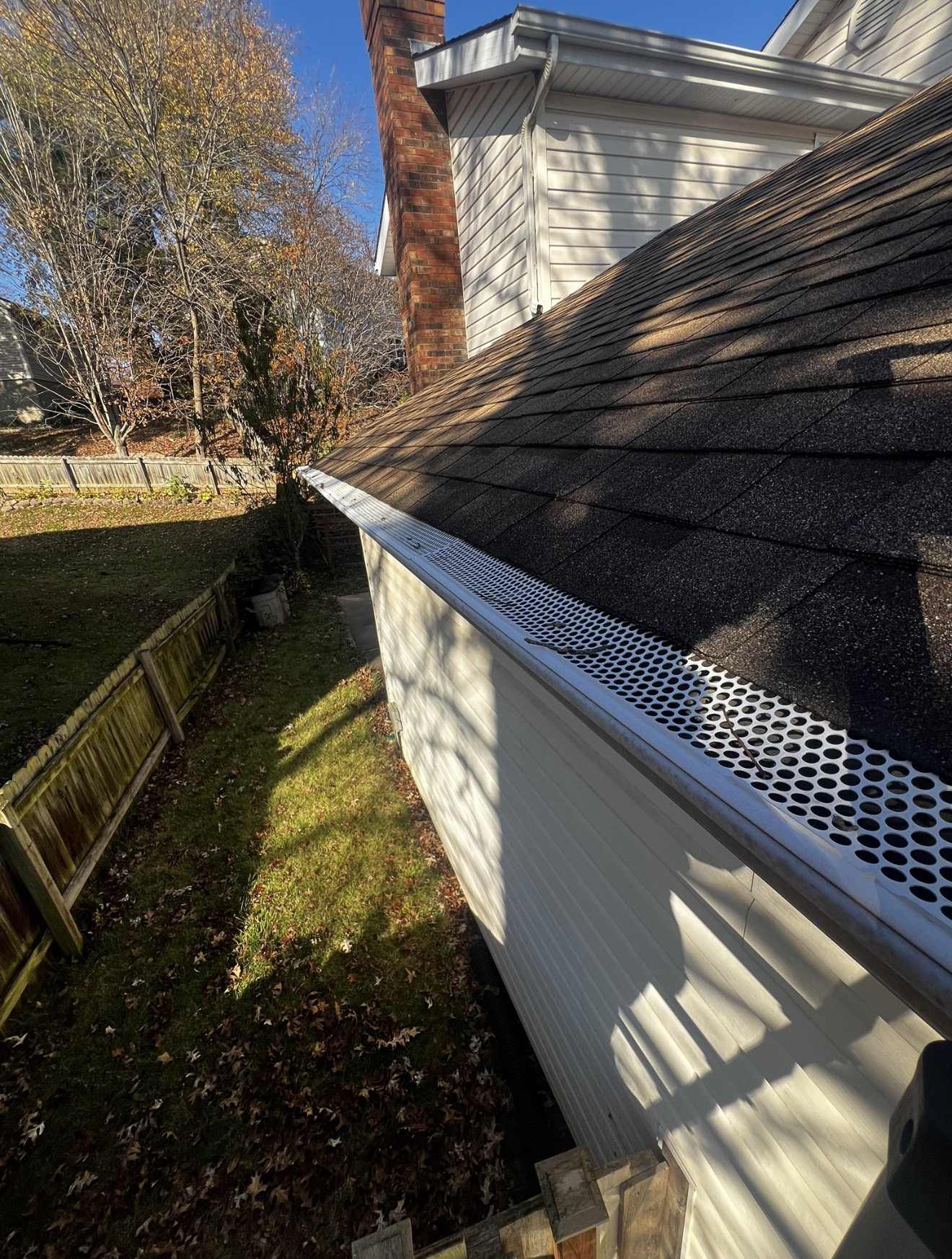
Reading direction before reading damage
Once the soft metal has been walked, there is usually a direction. Strikes concentrate on the elevations that faced the storm, and the opposite elevations are comparatively clean. That matters for two reasons. It tells the inspector which roof slopes deserve the most attention. And it gives a consistency check: if the metal says the storm came from the west and somebody is reporting marks evenly on all four slopes, one of those two observations is wrong.
This is also why an inspection that skips the soft metal and goes straight to the roof is weaker. It has thrown away the reference frame before it started.
Test squares, and what they are actually for
On the roof itself, the ordinary method is a marked test area on each slope, usually a ten foot square, in which every impact is located and counted. The point of a square is not to find the worst spot. It is to sample, consistently, so that slopes can be compared with each other and with whatever anybody else counts later.
A bruise in a shingle mat is felt as much as seen: the mat gives slightly under a thumb where the fibreglass has fractured, and the granules around the point are often loose rather than gone. That is why this cannot be done from a drone or from the ground, and why a verdict delivered from the pavement is not a verdict about anything.
Counting impacts is not deciding a claim. It is producing a record. What an insurer does with it is between you and your insurer, and no roofer in Missouri may negotiate that for you.
Things that look like hail and are not
Several ordinary conditions get reported as storm damage by people who want them to be, and a careful inspector rules them out before writing anything down.
- Blistering, where gas in the asphalt has raised small bubbles that later pop.
- Granule loss from foot traffic, usually in a path from the ladder point.
- Mechanical marks from a previous trade: an aerial fitter, a chimney sweep, a solar crew.
- Manufacturing surface irregularities on a new roof.
- Blisters are round, sharp edged and have no bruise under them.
- Traffic damage runs in lines and follows a route.
- Mechanical marks cluster around whatever was being worked on.
- Real impacts are randomly scattered and match the pattern on the soft metal.
Wind is a different reading altogether
Hail and wind leave completely different records and the metro gets plenty of both. Wind damage shows as creased tabs, tabs lifted at the corners with the sealant strip released, missing shingles usually starting at a rake edge or a ridge, and displaced ridge cap. It concentrates at edges and corners because that is where the pressure differential is highest, whereas hail is scattered across the field.
The two can happen in the same storm and the report should distinguish them, because they are different findings with different repairs. A creased tab is a mechanical failure of one shingle. A bruised mat is a change in the whole surface's condition.
What should exist when the walk is done
The same two things as any other inspection: photographs, including the soft metal and the condenser, and a written description of what was found, slope by slope, with the test square counts if any were taken. See the written scope.
And, if the answer is that the roof is fine, that written all clear is worth more after a storm than at any other time, because it is dated to a moment everybody will remember. That argument is made in full on the photograph set.