Free Roof Inspection, Greater St. Louis, On the Roof This Week
A ladder goes up at your eave, the whole plane is walked on foot, and every slope, penetration, flashing and discharge point is photographed. Days later you are holding the dated set and a written scope, whether there is work to do or nothing at all. Most of the people knocking on doors in this metro after a storm will not hand you either one.
- You keep
- A dated photograph set and a written scope, work or no work
- Costs
- Nothing, and nothing is signed on the day
- Covers
- Roofing, gutters and downspouts
- Area
- Greater St. Louis, both sides of the river bend
- Shingles
- Atlas and Malarkey
- Book it
- (314) 220-2333
Everybody offers the inspection. Almost nobody hands over the file.
Book one here and this is what happens. A ladder goes up at the eave. The plane gets walked on foot, because a fastener backing out, a lifted cap or a split boot cannot be seen from a driveway or from a drone. Every slope, every penetration, every flashing and every discharge point is photographed and dated. Then it comes back to you as a set you keep and a written scope describing what is there, including the scope that says there is nothing to do.
Compare that with the thirty minutes of access a door knocker needs. Free is free for them because the inspection is not the product, the contract is, and a homeowner who has lived through an April in St. Louis County already knows the pattern: a verdict from the pavement, three photographs on somebody's phone that you never receive, and a single page whose only number is a price. The route below is published in advance precisely so you can hold whoever turns up to it, this company included.
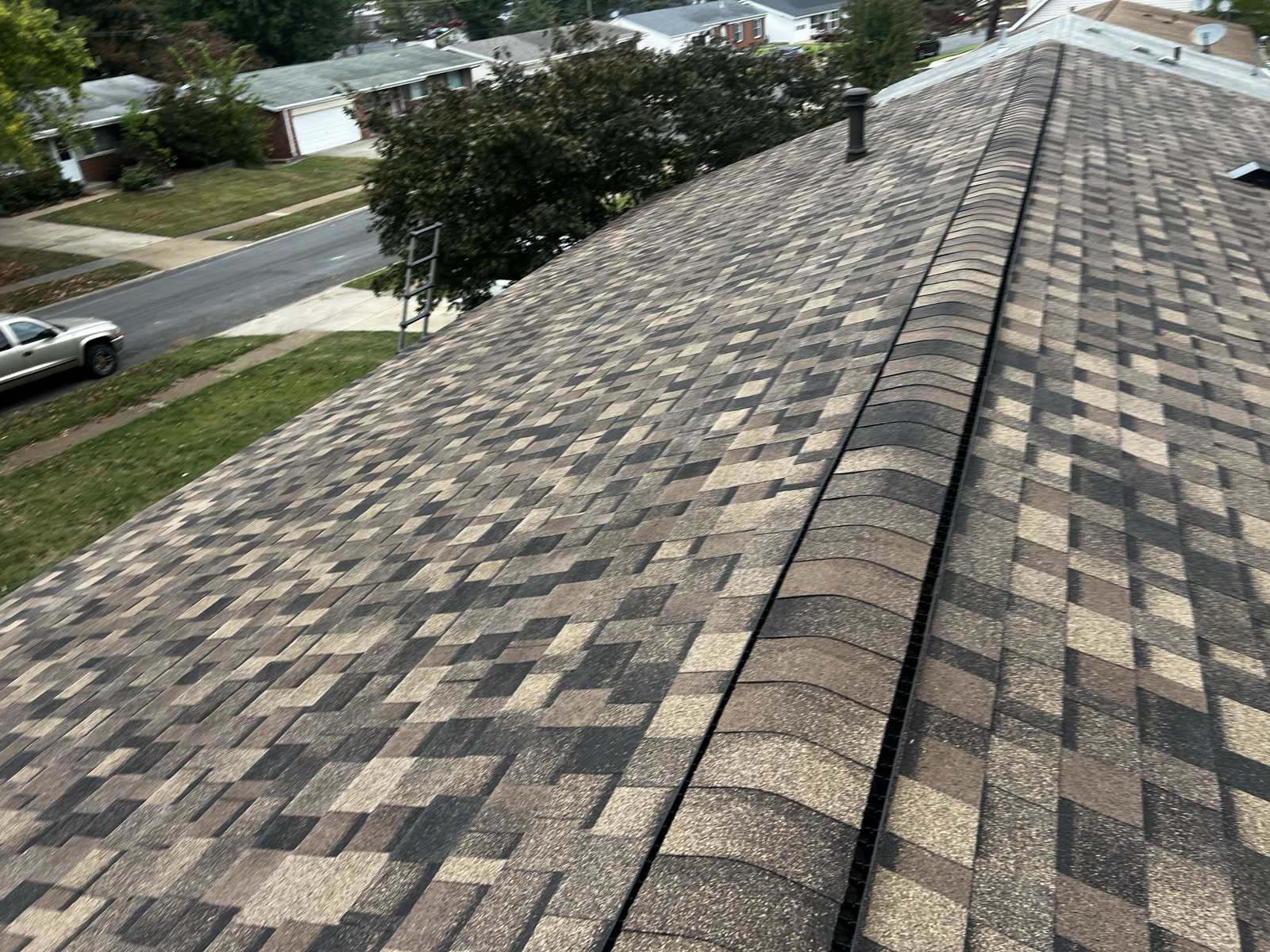
An inspection should end with something you can hold
The measure of an inspection is not how long it took or how friendly the person was. It is what exists afterwards. Two things should exist: a set of photographs, dated, of the roof as it is today, and a written scope describing what was found and what if anything is proposed.
Both should exist even when the answer is that there is nothing to do. Being told in writing that your roof is sound is worth having. It is the thing you show the next person who knocks, it is what you compare against after the next storm, and it is what stops a conversation four years from now about whether a mark was there before or arrived with the weather.
Photographs of each slope, the penetrations, the flashings, the gutters and the discharge points, and a written scope or a written all clear, handed over or emailed within a few days.
A verbal verdict at the kerb, three photographs on a phone that you never receive copies of, and a one page document whose only number is a price.
What actually gets looked at
A roof is not inspected by looking at shingles. Shingles are the last thing to fail and the first thing everybody stares at. The things that leak are the joints: every place where the roof plane is interrupted, turned, or asked to meet something that is not roof.
- Flashing at every wall and every chimney. Step flashing up the sides, counter flashing into the mortar joint, apron at the front, cricket behind a wide chimney. This is where a roof actually leaks.
- Pipe boots. The rubber collar around a plumbing vent perishes and splits, usually on the sun side, and it does it years before the shingles around it are worn out.
- Valley metal. Where two planes meet, the water concentrates. Open valleys, closed cut valleys and woven valleys each fail differently and each get looked at differently.
- Ridge and soffit ventilation. Exhaust at the top, intake at the bottom, and whether the intake is blocked by insulation, which it very often is.
- Fasteners. Nails that are high, overdriven, underdriven or backing out. On a roof that was installed in a hurry this is the whole story.
- The gutters, and where the downspouts discharge. Not decoration. The gutters are part of the roof system and the discharge point is part of the foundation's life.
There is a page for each of these. Start at the walk if you want the full sequence in the order it happens.
On a storm call, the soft metal is read first
If the reason for the visit is a storm, the sequence changes. Nobody who knows what they are doing starts on the shingles. They start on the soft metal, because aluminium and thin steel take a dent and keep it, while an asphalt shingle mat can absorb an impact and show almost nothing from six feet away.
So the gutters get read along their length, the downspouts get read on the exposed side, the vent caps and turbine housings get read, and the fins on the air conditioning condenser at ground level get read, because a condenser is a metal record of what fell in the garden. Only then does anyone start putting test squares on the roof itself. The whole of that logic is set out on soft metal first.
Finding a dent in a gutter is not the same as finding damage to a roof, and neither one is a claim. Both are information, both are photographed and dated, and both end up in your hands. What you do with the file after that is entirely yours.
What a Missouri roofer cannot offer, and why that helps you
Missouri regulates roofing contractors in one narrow but very useful way. Under RSMo 407.725 a contractor may not represent or negotiate a homeowner's insurance claim, nor advertise that it will, and the same section bars a roofing contractor from advertising that it will pay, waive, absorb or rebate any part of an insurance deductible.
Read that as a filter rather than a restriction. Two of the most common things said on doorsteps in this metro after a storm are things a compliant contractor is not permitted to say. Someone who offers to handle your claim is offering you something the statute forbids, and someone who offers to make your deductible disappear is doing the same. You do not need to know anything about roofing to use that. The full explanation, with the rest of the Missouri picture, is on what a roofer cannot offer.
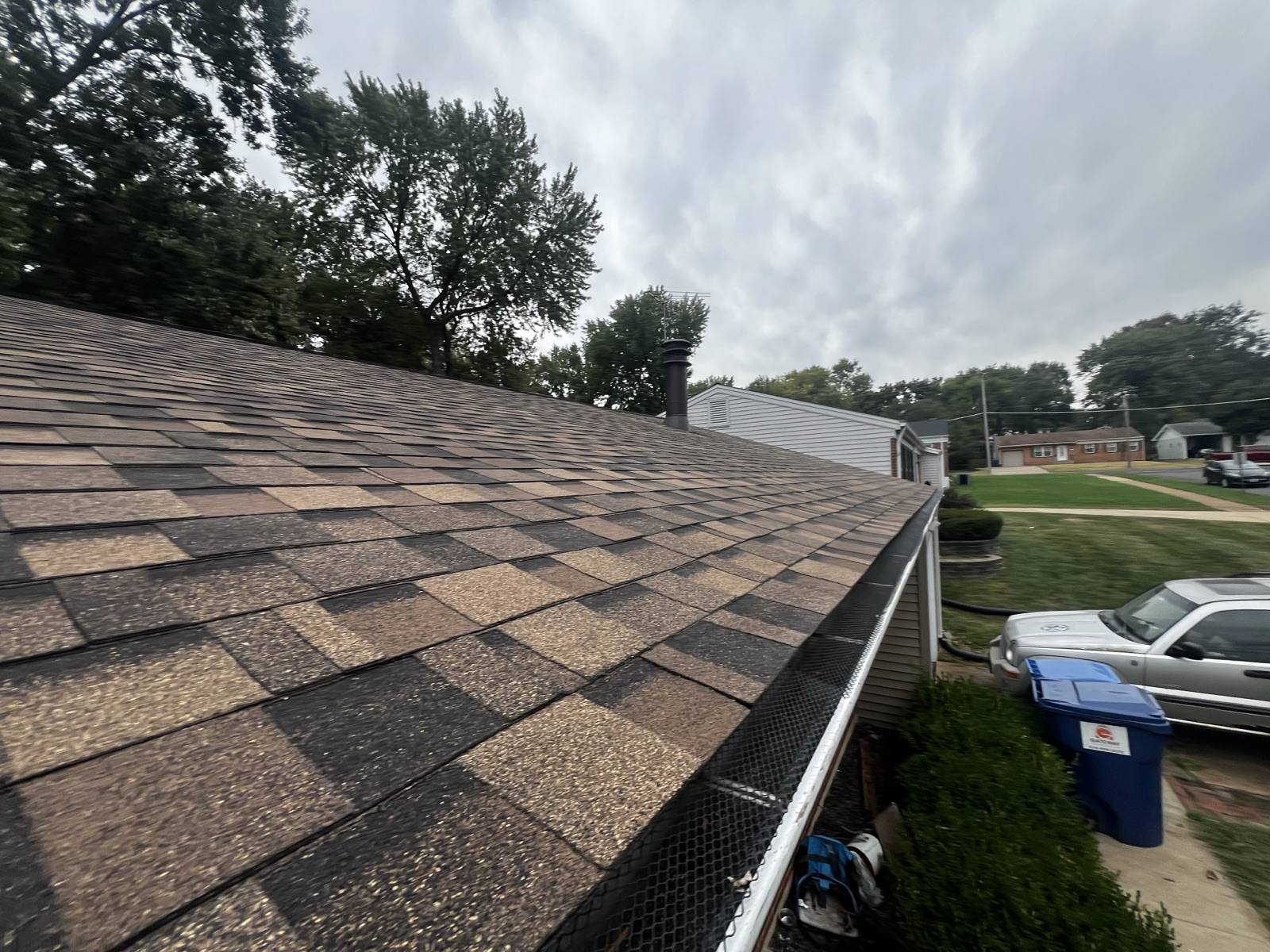
The most useful document a homeowner here can own
It is a dated set of photographs of an intact roof. Not a damaged one. An intact one.
The reason is simple. Almost every disagreement about a roof in this metro is a disagreement about time: whether a mark was there already, whether a lifted shingle is wind or workmanship, whether wear is wear or weather. Without a dated record, that argument is conducted from memory, and memory is not evidence. With one, it stops being an argument and becomes a comparison, and a comparison can be resolved by two people looking at two pictures.
Which is why an inspection that finds nothing is still worth having, and why the photographs matter more than the verdict. See the photograph set for what a useful set contains and how to keep it somewhere you will actually find it.
Warning signs, at the door and on the roof
Five things, any one of which should slow the conversation down.
- A verdict before anybody climbed. Nobody can see a pipe boot from the pavement.
- Pressure to sign today, or a discount that expires when the van leaves.
- An offer about your deductible in any form at all.
- An offer to take your insurance claim off your hands.
- A report that is a price rather than a description of work.
- A document signed at the door that is an authorisation rather than a quote.
- No photographs, or photographs you are shown but never given.
- A company name you cannot find a fixed address for.
Each of these is unpacked, with what the honest version of the same moment looks like, on warning signs at the door.
When one is actually worth booking
Four occasions. When the roof passes fifteen years or so and you have no paperwork on it. In the weeks after a storm that you know was overhead, once the street has gone quiet again. Before you list a house, or after an offer is accepted on one you are buying. And before winter, if you have never had the flashings looked at, because a chimney flashing that is going to fail will do it in February and not in June.
The seasonal picture for this metro is real and worth knowing. April and May together carry roughly fifty six per cent of the metro's annual hail reports in the NOAA Storm Prediction Center climatology for the local forecast area. That is when the calls come, which is also when the doorsteps get busy. When to book one sets out the county level record and, more importantly, what it does not tell you about your own house.
Measure whoever turns up against it, including us
The phone number at the top of every page is Keys Roofing's, and if you ask for an inspection through this site, a Keys crew is who arrives. Roofing, gutters and downspouts, nothing else. Atlas and Malarkey shingles. Licensed and insured. The same route is what a Keys estimator walks, in the same order, and the same two documents come back down the ladder.
Everything on these pages is written so it stays true whether you call Keys or call somebody else. If the route below matches what your roofer does, that is a good sign about your roofer. If it does not, that is worth knowing too, and it is worth knowing before anybody asks you to sign anything.
The route in full
What gets looked at
The route an inspector actually walks, from the ground line to the ridge and back down to where the downspouts discharge.
Station 02Soft metal first
On a call after a storm the gutters, vents and condenser fins get read before the shingles do, because soft metal keeps a record the shingle mat hides.
Station 03Ridge, soffit, attic
Intake and exhaust are the half of a roof that nobody sells and everybody blames later. What is checked, and why a blocked soffit outlives two roofs.
Station 04Gutters and discharge
Where the water actually goes once it leaves the roof, and the four things that decide whether it goes there quietly.
Output 01The written scope
A scope is a description of work. A price is a number. You should be handed the first one, whether or not there is any work to do.
Output 02The photograph set
A dated set of photographs of an intact roof is the single most useful document a homeowner in this metro can own.
Filter 01Warning signs at the door
A verdict before anyone climbed, pressure to sign on the spot, an offer about your deductible. What each one actually tells you.
Filter 02What a roofer cannot offer
Missouri bars a roofing contractor from doing several of the things storm crews advertise loudest. Knowing the list is a filter you can use at the door.
TimingWhen to book one
Roof age, the weeks after a storm, and what the hail record for this metro does and does not say about your house.
AfterwardsAfter the inspection
The three honest outcomes, the permit question, and the one thing nobody can tell you until the old material comes off.