Free Roof Inspection STL / Station 04
Water at your foundation usually starts at the gutter line
A roof is not finished with the water when it leaves the shingles. It is finished when the water is somewhere that does no harm. Keys does gutters and downspouts as well as roofing, so the whole path gets walked, photographed and written up on one visit rather than two.
Gutters are roofing, not trim
Gutters get treated as a slightly cosmetic thing hanging off the edge of a house, and then they put water into the four places that cost the most to repair: the fascia, the soffit, the wall behind and the ground against the foundation. They are the last section of the path, they are on the inspection, and they are photographed on the same morning as the slopes. Most companies in this metro will look at your shingles and leave the rest for somebody else.
Keys does roofing, gutters and downspouts and nothing else, which is why they are on the same report. A roof that is in good order draining into a gutter that overflows into a soffit is not a house with a gutter problem. It is a house with a wet soffit.
The four things that decide whether a gutter works
- Pitch. A gutter needs a consistent fall towards each outlet. Too little and it holds water, too much and it looks wrong and overshoots at the ends. Standing water in a dry spell is the easiest finding there is, and it is visible from an upstairs window.
- Hanger spacing and fixing. Hangers too far apart, or fixed into rotten fascia, let the run sag between them, which creates its own low points and undoes the pitch.
- Seams and outlets. On a seamless run the joints are at corners and at outlets, and those are where the sealant fails first. On older sectional gutter every joint is a candidate.
- Capacity and the drip edge relationship. Whether the water leaving the roof lands in the gutter at all, which depends on where the drip edge sits and how steep the slope is. A steep roof in heavy rain can throw water clean over a correctly hung gutter.
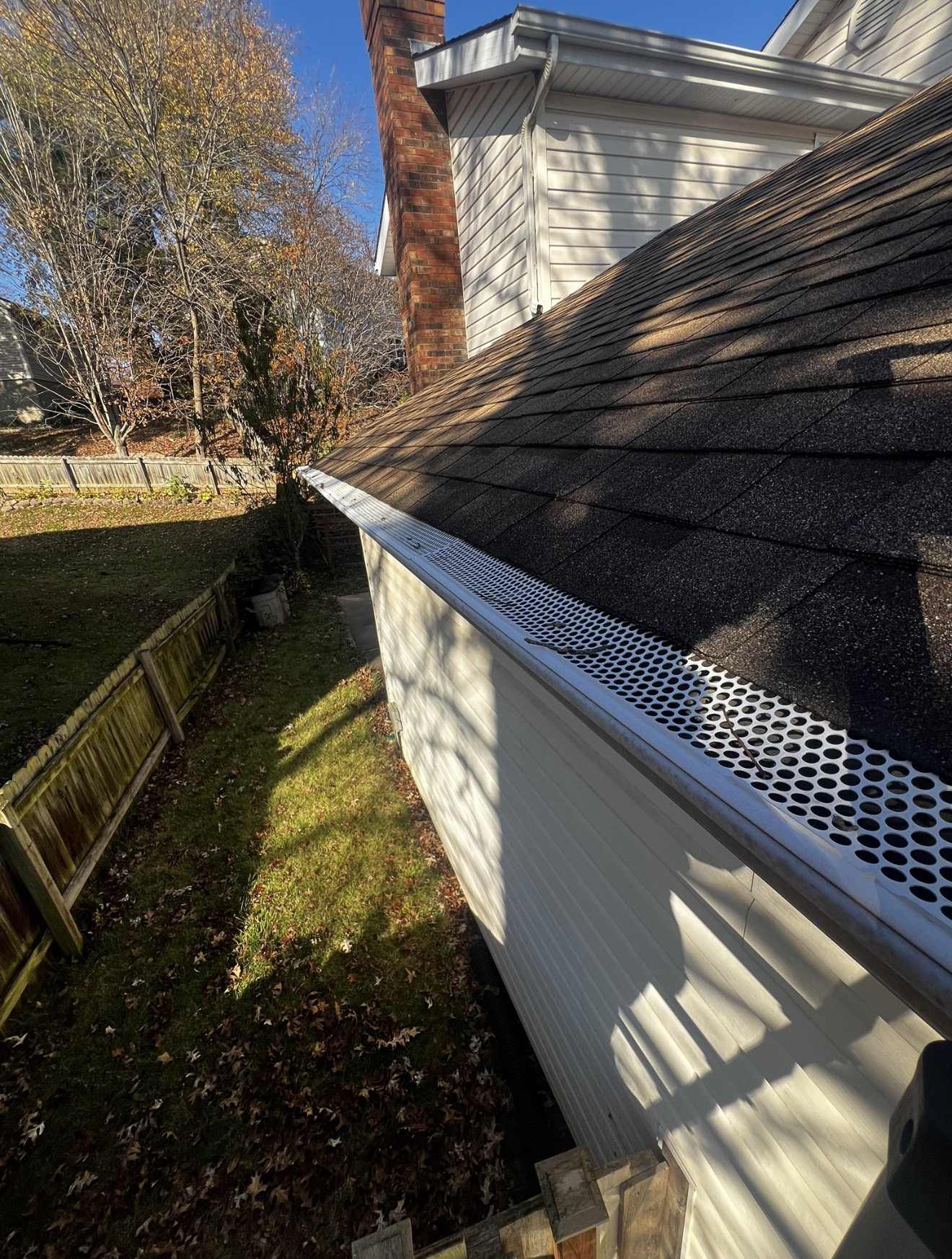
Guards, honestly
Gutter guards are worth having on a house under trees, which in most of these neighbourhoods is most houses. They are not maintenance free and nothing sold as maintenance free is. What they do reliably is keep leaves and larger debris out of the trough so the run does not block solid in October. What they do less reliably is keep out shingle grit, pine needles and maple keys, which are small enough to pass most designs and then settle in the bottom.
On an inspection a guard gets checked for lifting at the fixings, for debris sitting on top of it rather than in the gutter, and for whether it has been fitted under the first shingle course in a way that lifts that course, which happens and which causes a different problem entirely.
A guard reduces how often a gutter needs clearing. It does not end it. Any claim stronger than that is a sales claim rather than a description of a product.
Downspouts, and the joint everyone forgets
A downspout is checked along its length for separation at the joints, for crushing at the bottom where a mower or a bin has caught it, and for whether the elbow at the top is actually seated in the outlet. It is also checked for being connected at all: a downspout that has been detached to get at something and never put back is a common and entirely invisible finding, because from the front of the house it looks identical.
Sound is a useful test in rain. A downspout that is running properly makes a steady note. One that is blocked makes almost none and the gutter above it overflows quietly at the far end where nobody is looking.
Where the pipe lets go, which is the point of the whole exercise
The last stop on the walk. A downspout that discharges against the wall is delivering the entire roof's water to the one place you least want it. The fix is usually an extension, a splash block or a buried line, and the finding is usually that one of those existed and has since been removed, mowed over, or crushed.
The ground at the discharge point is read as well. A scour hole, a channel worn into a bed, or a patch of ground that stays soft in dry weather all say the water is going somewhere it should not. On a house with a basement, which is most of them here, this is not a small point.
Ice at the eave is usually not a gutter fault
Every winter, gutters get blamed for ice. Ice dams form when heat escaping into the attic melts snow on the upper roof, the meltwater runs down to the cold overhang beyond the heated space, and it refreezes there. The gutter is simply the object that ice ends up sitting in and pulling on.
So an inspection that finds ice damage at the eave should look upward, not downward, and check the intake ventilation and the insulation at the eave. That is on ridge, soffit and attic. Replacing a gutter that ice tore off, without addressing the reason ice formed there, buys you one winter.
Fascia and soffit, since the gutter hangs on them
The board behind a gutter takes the entire load of the run plus whatever water and ice it holds. Where it has been wet for years it goes soft, the hanger screws lose their grip, and the run starts to sag, which makes the standing water worse, which keeps the board wet. It is a loop and it is worth catching early.
Soffit gets read at the same time for staining, for panels that have dropped out of their channel, and for the perforations that are the roof's intake ventilation. On a lot of houses in this metro the soffit is doing two jobs at once and only one of them is visible from the garden.