Free Roof Inspection STL / Output 02
Get your roof photographed now, while it is still intact
April and May carry about 56 per cent of this metro's annual hail reports in the NOAA Storm Prediction Center climatology. A dated set of an undamaged roof, taken before the season rather than after it, is the single cheapest document a homeowner here can own, and it costs nothing to get.
Almost every disagreement about a roof is a disagreement about time
Not about what is on the roof. About when it got there. Was that mark there before the storm. Is that lifted tab wind or is it workmanship. Is the wear on the south slope ordinary ageing or the hail from three years ago. Those questions arrive constantly, they are all the same question, and without a record they are all answered from memory, which is to say answered by whoever sounds most certain. A dated set answers them in four seconds and you only have to get it once.
Memory is a poor witness about roofs. Nobody looks at their own roof carefully enough to remember it. So the argument gets conducted between two people who are both guessing, one of whom does this for a living, and it is decided by whoever is more confident. A dated photograph ends that. It converts an argument into a comparison, and a comparison can be settled by two people looking at the same two pictures.
What a useful set actually contains
Not fifty photographs. Twenty or thirty, deliberately taken, is a better record than two hundred taken at random.
- Each slope, whole. One frame per plane, from a consistent position, far enough back that the whole plane is in it.
- Each slope, close. One frame close enough to see individual shingles and the granule surface.
- Every penetration. Each pipe boot, each flue, each vent, individually.
- Every flashed junction. Each chimney from at least two sides, and each wall intersection.
- The valleys. Along the line, not across it.
- The ridge and the exhaust. Along the ridge, and any box vents or turbines.
- The eaves and the gutters. Along each run, including the inside of the gutter.
- Each discharge point. Where the downspout ends and what the ground looks like there.
- The attic, if there is access. The underside of the decking, the insulation depth at the eave, and any staining.
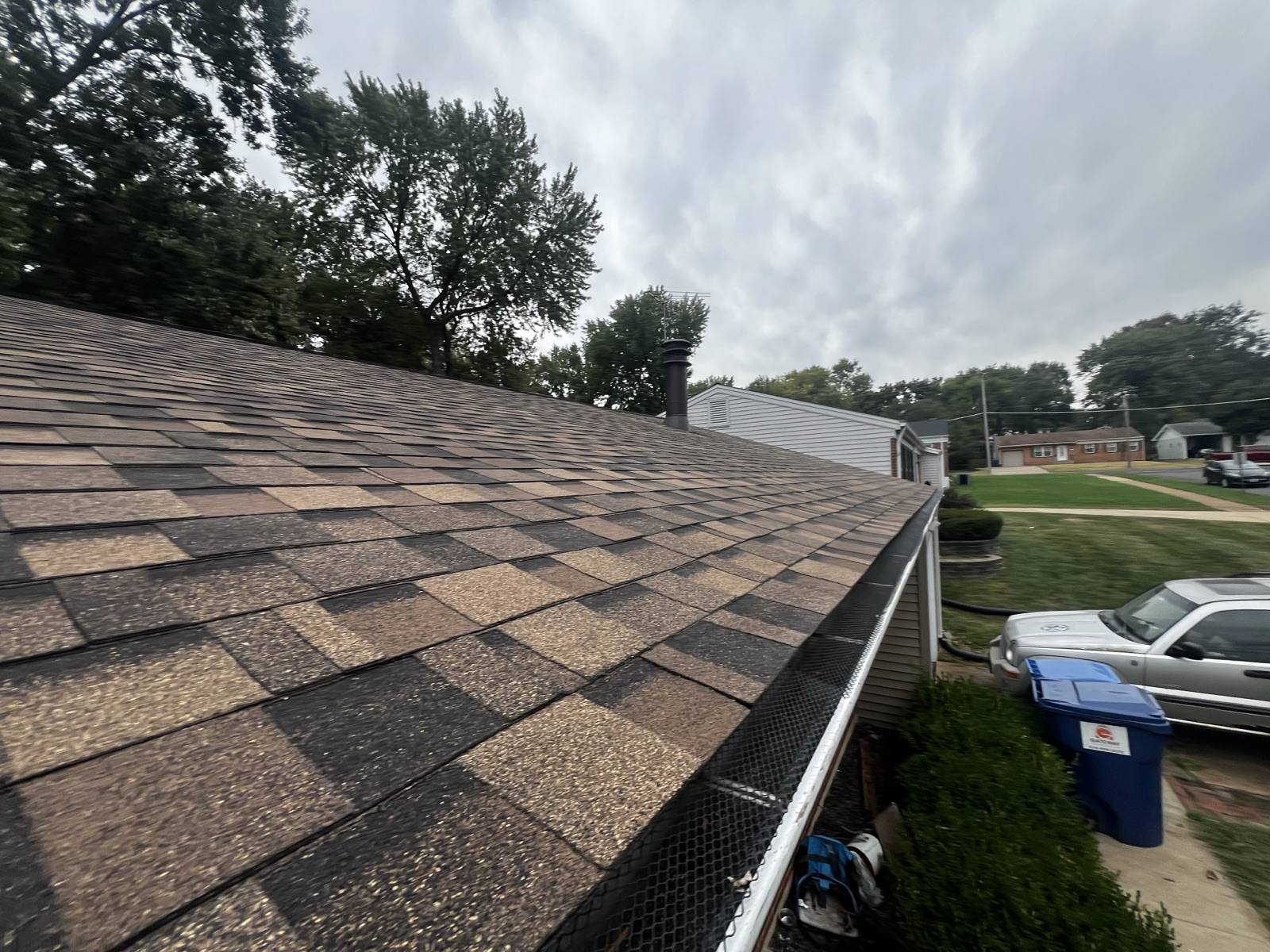
The date is the whole value, so protect it
A photograph with no reliable date is a picture. The date is what makes it evidence of anything. Digital photographs carry their date internally in the file, which survives being copied to a cloud drive and does not survive being screenshotted, printed, or sent through some messaging apps that strip the file data on the way.
So keep the originals. If a roofer emails you a PDF report with the photographs embedded, that is useful and it is not the same thing, because the images inside it have usually been compressed and stripped. Ask whether the original files can be sent. Most companies will simply share a folder link, and that is the version to keep.
What a photograph can settle, and what it cannot
- Whether a feature existed on a given date.
- What the surface condition of the field was on that date.
- Whether a flashing was new, reused or absent.
- How many layers were visible at an exposed edge.
- What the gutters and discharge points looked like.
- What caused something. A dent is a dent in a photograph.
- Whether anything is covered by a policy. That is between you and your insurer.
- Whether a roof has remaining service life, which is a judgement.
- The condition of decking under a finished roof, which nobody can photograph.
That second column matters. A photograph is a record of appearance on a date. It is extremely good at that and it is not a verdict on anything else, and anybody presenting it as one is overreaching.
You can start this yourself, from the ground, today
You do not need a ladder and you should not get on your own roof. Stand at each corner of the property and at the middle of each elevation and take one wide frame of each. Then use the zoom to take one closer frame of each plane, each chimney, and each visible vent. Then photograph the inside of the gutters where you can see them from an upstairs window, and each downspout where it discharges.
That takes about fifteen minutes and it produces a record that is worth having even though it is worse than a set taken on the roof. Do it once a year, in the same month, and by the third year you have something genuinely useful: a sequence, which shows rate of change rather than just condition.
Where to keep it so you can find it in four years
One folder per property, one subfolder per year, on a service that is not the phone you are holding. Phones get lost, dropped and replaced, and a photograph that only exists on a phone that went in a lake is not a record. Name the folder something you would actually search for, which usually means the street name and the year rather than anything clever.
Put the written scope in the same folder. The pair of them together, photographs plus a written statement of condition, is a far stronger record than either one on its own, because the scope says what a professional thought about what the photographs show.
The second set, after something happens
If a storm goes over, take the ground level set again as soon as it is safe, before anybody knocks. Same positions, same order. Two sets from the same corners of the same garden, taken eighteen months apart, are worth more than any single set taken by anybody, because the comparison does the work for you and no interpretation is required.
Then, if there is anything to look at, have it looked at properly. When to book one covers the timing, and soft metal first covers what a competent person looks at after a storm and in what order.